


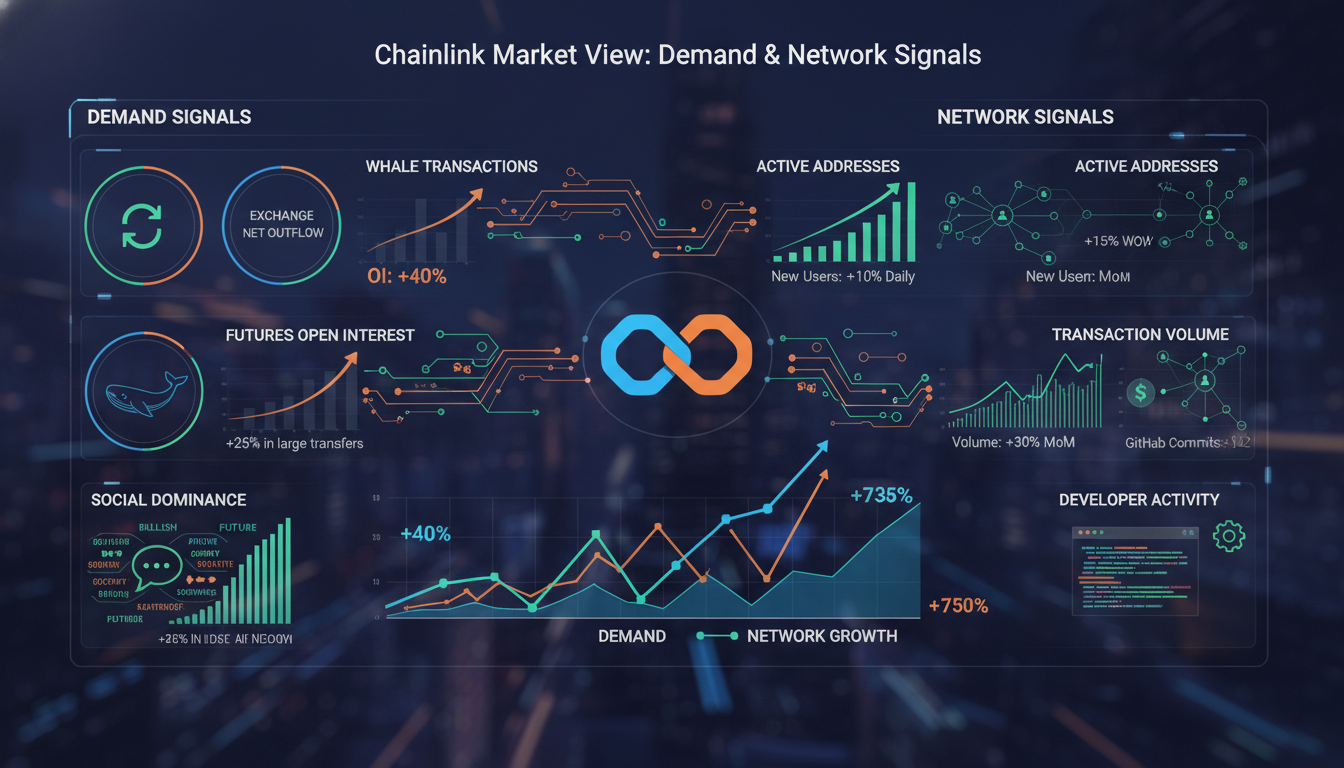
Chainlink Market View: Demand and Network Signals shows a complex picture—demand is steadily rising at the institutional level while broader network signals like retail activity and transaction volume show mixed trends. Simply put, Chainlink’s oracle infrastructure is gaining ground among enterprises, but retail engagement and speculative activity remain uneven.
Demand Drivers: Institutional Adoption and TVE Growth
Chainlink has seen explosive growth in Total Value Enabled (TVE), topping $20 trillion in Q1 2025 and rising to approximately $26 trillion according to recent estimates . This reflects its expanding utility across DeFi, tokenized assets, and enterprise systems.
CCIP (Cross‑Chain Interoperability Protocol) continues to be a major adoption vector—now deployed across 50–60+ chains and securing over $24 billion in token value . New oracle features like Data Streams, Multistream, and OHLC APIs further boosted performance, with streams throughput growing over 700% in early 2025 .
Notably, partnerships with the U.S. Department of Commerce, UBS, WisdomTree, Ripple, S&P Global, and SWIFT highlight Chainlink’s expanding footprint in traditional finance . Government macroeconomic data such as GDP and PCE Price Index are now brought onchain via reliable Chainlink feeds, enabling DeFi protocols and automated systems to use trusted data in real time .
The result? Chainlink dominates the oracle market, commanding between 63–67% share, with its infrastructure underpinning a large majority of DeFi protocols and cross-chain use cases .
“Chainlink’s ability to bridge DeFi and traditional finance through secure, real-world data feeds is what makes it central infrastructure for the next generation of financial systems.”
Network Signals: Diverging Clues from On‑Chain Metrics
On-chain data paints a nuanced picture. Whale activity remains strong, with large holders accumulating over 40 million LINK by late 2025 and holding over 3,000 daily active addresses . Moreover, social sentiment on Chainlink remains strongly bullish, with a 3.3-to-1 bullish-to-bearish commentary ratio .
On the flip side, some retail signals are cooling. New and active addresses dropped significantly—from nearly 2,900 to under 900 in a couple of months . Exchange reserves also show a shift—LINK tokens exiting exchanges suggest accumulation, but user engagement isn’t always following suit .
Technicals add complexity. A breakdown below $13.50 could lead to a push down toward $13.30 . Yet supply squeezes—thanks to low exchange reserves and staking mechanisms (staking v0.2)—support bullish technical setups targeting $25 and even $30+ .
Synthesis: Crossroads of Demand and Sentiment
Putting it all together:
- Institutional demand is surging. Real-world asset tokenization, macro data access, and enterprise partnerships are creating strong, long-term utility for Chainlink.
- Network sentiment remains optimistic. Whale accumulation and positive social chatter support expectations of sustained growth.
- Retail and speculative signals are uneven. Declining new addresses and social engagement hints at caution among non-institutional users.
- Technicals are neutral-to-bullish. Supply constraints could support further price gains, though breakdown risks persist near $13.30–$13.50.
What to Watch Next
Several key signals could shift the outlook:
- Chainlink Reserve growth. As the strategic token reserve accumulates LINK, it could buffer volatility and support long-term valuation. Recent reports show reserve holdings nearing 110k LINK .
- New ecosystem integrations. Expanded use in DeFi, RWAs, and TradFi (e.g., NAV feeds, SWIFT, ICE) could further increase structural demand .
- Renewed retail activity signals. A bounce in active addresses or social growth would reinforce broader adoption.
- Clearer tokenomics traction. As demand for oracle services equals or surpasses subsidies—especially through staking and real-world data monetization—LINK holders could benefit from greater value accrual .
Conclusion
Chainlink is standing on a compelling foundation. Enterprise demand is real, value-enabled metrics keep growing, and market sentiment leans positive. But unless retail engagement and speculative attention return, momentum may hinge on institutional deployment and token utility being increasingly tied to demand growth.
Key takeaways:
- Real-world partnerships and on-chain demand are fueling two orders of trillion-level growth in TVE.
- Whale behavior and sentiment remain bullish, indicating confidence in long-term positioning.
- Retail activity and technical indicators are mixed—support below $13.50 is critical, but supply constraints could spur a breakout.
- Tokenomics and broader adoption trends will be key catalysts—especially as Chainlink’s Reserve strengthens and more use cases arise.
FAQs
Why is Chainlink’s Total Value Enabled (TVE) important?
TVE represents the total on-chain value reliant on Chainlink oracles. Its rapid growth into the tens of trillions signals deepening integration across DeFi, tokenization, and real-world use cases.
What does CCIP’s expansion signify?
CCIP’s deployment across 50+ blockchains and handling billions in token value shows Chainlink is becoming foundational infrastructure for cross-chain transfers and messaging.
Are whales accumulating LINK?
Yes—whale-held LINK and daily active addresses have both climbed, and social sentiment remains bullish, suggesting these actors are positioning for long-term value increases.
What downside risks are present?
Declining new addresses and reduced retail activity could dampen speculative demand. Technically, falling below $13.30–$13.50 may open the door to further price drops.
How might tokenomics evolve to benefit holders?
As real demand for oracle services rises and staking mechanisms mature, subsidies may give way to fee-based value capture, increasing long-term holder benefits.
What upcoming indicators should be monitored?
Watch Chainlink Reserve accumulation, new institutional integrations, resurgence in active addresses, and on-chain demand metrics; these signal whether Chainlink continues climbing or hits consolidation.

















Leave a comment