


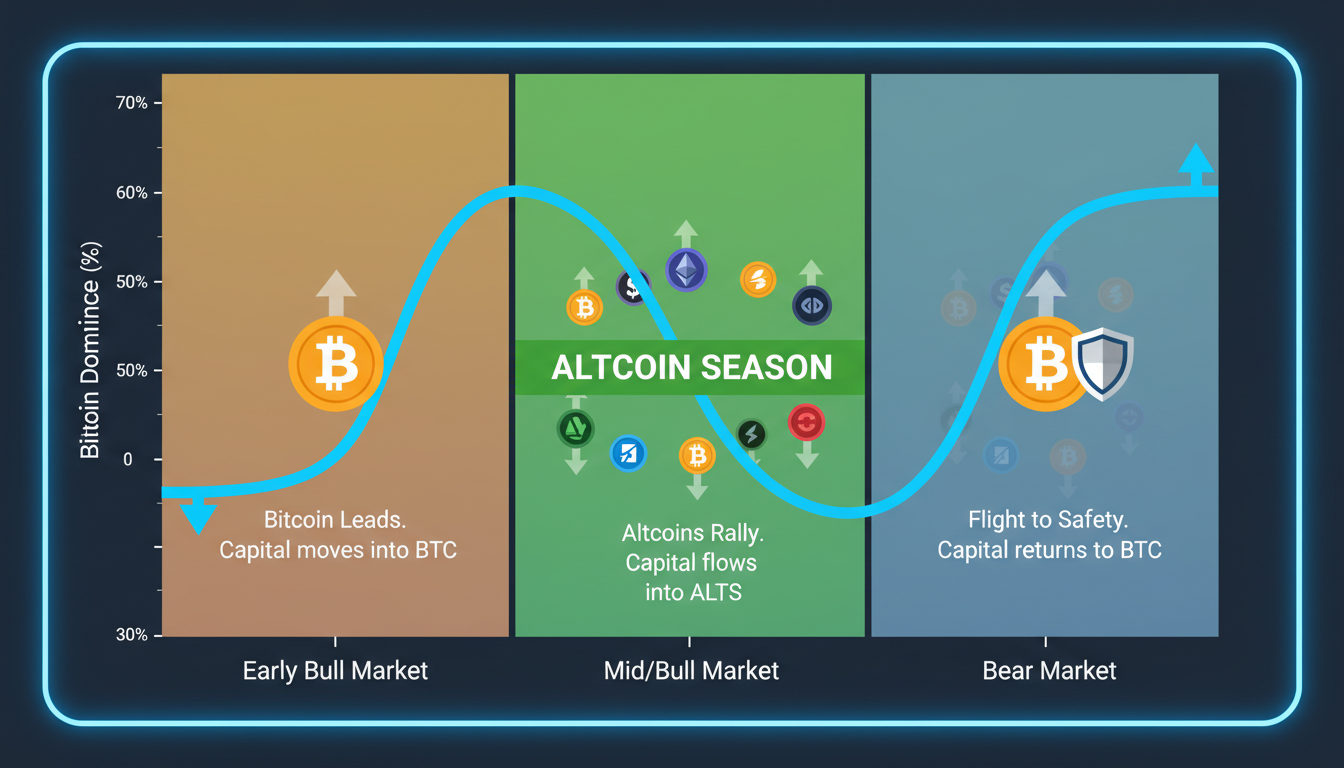
Bitcoin dominance refers to the percentage share of Bitcoin’s market capitalization relative to the total cryptocurrency market. It tells us how much Bitcoin leads the market. A high dominance means fewer resources for altcoins, while a drop often signals that altcoins are gaining attention and possibly outperforming. Let’s break down why this matters for altcoins and how it shapes the broader crypto ecosystem.
What Is Bitcoin Dominance and Why It Matters
Bitcoin Dominance (often referred to as BTC.D) is calculated by comparing Bitcoin’s market cap to the combined market cap of all cryptocurrencies. When BTC.D rises, it usually indicates that investor confidence is concentrated in Bitcoin, often due to perceived safety or strong macro sentiments. On the flip side, when BTC.D declines, capital flows toward altcoins, which may ignite so-called “alt seasons.”
This metric is closely watched by traders and analysts. It helps them understand market risk appetite and whether capital is being rotated into riskier, potentially higher-return opportunities like altcoins.
How Bitcoin Dominance Affects Altcoins
High Dominance: Altcoins Face Headwinds
When Bitcoin dominance increases:
- Altcoins often struggle in both USD terms and against Bitcoin.
- Liquidity flows back to Bitcoin, leaving altcoins with reduced trading volume and attention.
- Market uncertainty or macro-focused risk-off sentiment is usually at play.
For example, in April 2025, BTC.D surged to about 64%, its highest since 2021, sinking Ethereum’s share from 13% to 7% of the market. Increased institutional demand and ETF inflows have been key drivers here.
Low Dominance: Altcoins Thrive
When BTC.D falls:
- Altcoins often rally significantly, sometimes outperforming Bitcoin by double-digit gains.
- This phase, known as “alt season,” sees enthusiasm shift toward mid- and small-cap projects.
During such periods, meme coins and speculative assets often skyrocket—driven by hype and narrative, sometimes beyond fundamentals.
Market Conditions That Drive Bitcoin Dominance
Institutional Inflows & ETFs
Since the approval of Bitcoin spot ETFs in early 2024, institutional capital has flowed heavily into BTC. That has pushed BTC.D higher, as seen with its climb to 64% in early 2025.
Macro Uncertainty & Risk Aversion
Tensions like geopolitical conflicts or economic instability push investors toward the perceived safety of Bitcoin. This shift reinforces BTC dominance at the expense of altcoins.
Liquidity Imbalance and Market Structure
Fund managers and ETFs hold a large portion of crypto assets—primarily Bitcoin and Ethereum. Another chunk is held by VCs in altcoins. This imbalance makes smaller projects vulnerable due to liquidity constraints, especially when BTC.D is rising.
Patterns and Cycles: When Does Altseason Kick In?
Altseason tends to follow a major Bitcoin rally. Once BTC stabilizes or moves sideways, investors start rotating into altcoins in search of outsized returns.
Seasonal patterns show that altcoins often shine in mid-year, such as June or July. If BTC.D peaks—analysts suggest it could approach 71%—we may see altcoin resurgence afterward.
Emerging Themes Beyond Traditional Crypto
Beyond usual altcoins, newer narratives like Real World Assets (RWA) tokens are gaining traction. These tokens reflect real-world assets—stocks, bonds, real estate—and may catalyze a more sustainable altcycle.
Expert Insight
“Historically bitcoin dominance has been cyclical. We’d expect a handoff to alts once bitcoin gets meaningfully above its all‑time high, as happened in the last cycle.” — Seth Ginns, CoinFund
This view underscores how market cycles and narrative shifts can influence dominance dynamics.
Real-World Examples
- April 2025: BTC.D soared to multi-year highs (~64%), altcoins like Ethereum lost market share, while ETFs and institutional demand powered Bitcoin’s run.
- July 2025: BTC.D fell by nearly 6% in one week (to ~61%), coinciding with altcoins like Ethereum driving market capitalization growth.
- Recent trend: BTC.D remains elevated—over 55%—indicating a cautious market environment with potential consolidation ahead.
Conclusion
Bitcoin Dominance is a powerful barometer of market mood. A rising BTC.D usually signals risk-off sentiment and pressure on altcoins. A falling BTC.D, on the other hand, often marks the start of altseason and speculative bullishness. Institutional flows, regulatory clarity, and macro trends all shape these cycles. For investors, understanding dominance trends can guide strategic moves between Bitcoin and altcoins.
FAQs
What exactly is Bitcoin Dominance?
Bitcoin Dominance measures Bitcoin’s share of the total crypto market valuation. It helps gauge whether the market favors BTC or is shifting toward altcoins.
Why do altcoins sometimes outperform even when Bitcoin is strong?
After a strong Bitcoin rally, investors may chase higher returns in altcoins. That’s when BTC.D dips and altcoins often outpace Bitcoin.
Can altcoins gain even if BTC.D remains high?
Yes—some altcoins may show resilience against the USD, but they usually underperform BTC. Research altcoin/USD and altcoin/BTC pairs separately for clarity.
Do ETFs affect Bitcoin Dominance?
Spot Bitcoin ETFs have concentrated investor flow into BTC, boosting its dominance. Altcoin ETFs lag behind, limiting capital rotation into altcoins.
When is altseason likely to happen?
Altseason often emerges after Bitcoin’s rally, as capital rotates into altcoins. Historically, mid-year months like June or July are common altseason windows.
How can traders use BTC.D in strategy?
Traders monitor BTC.D for risk sentiment and rotational signals. A rising BTC.D may prompt defense (move into BTC), while a falling BTC.D could signal an opportunity in altcoins.





















Leave a comment