


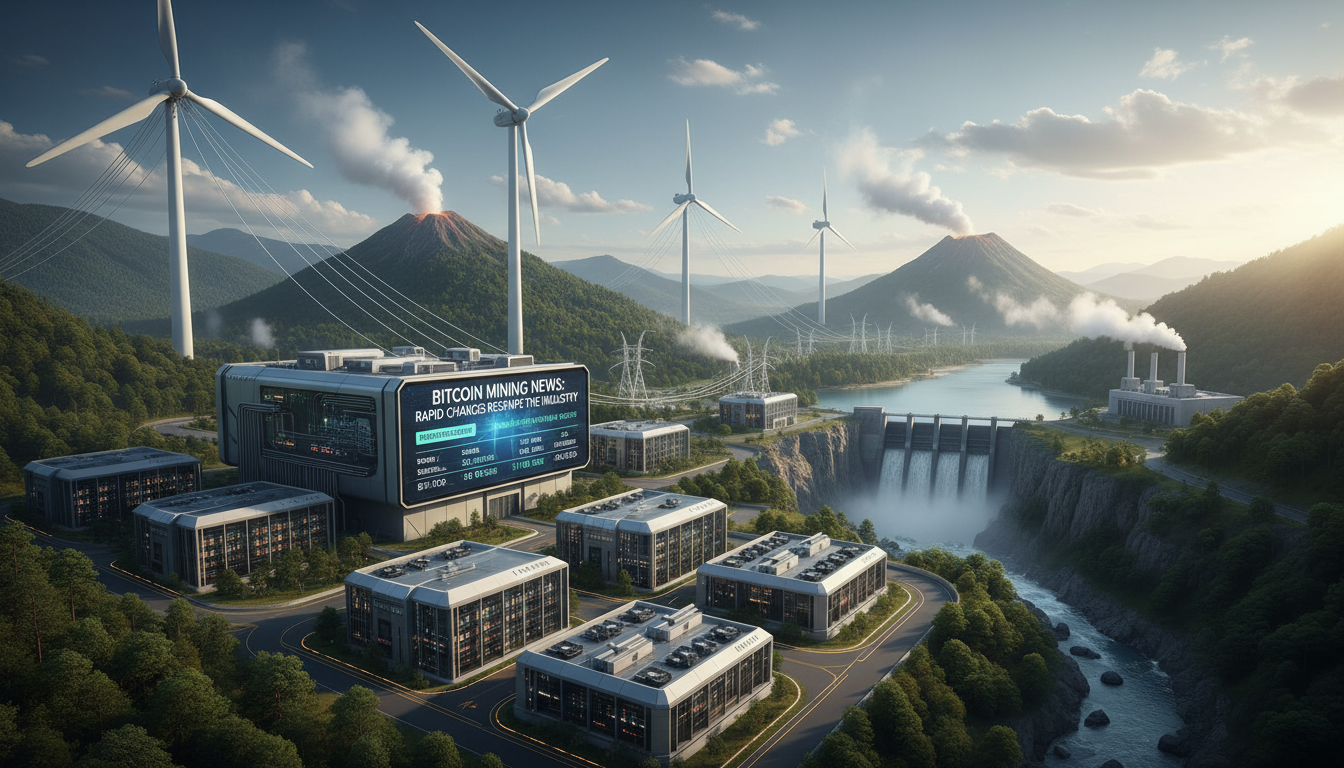
Bitcoin mining is undergoing a seismic shift as companies streamline operations in response to shrinking block rewards, soaring energy costs, and institutional pressure. The industry is rapidly transforming—from pure hashrate competition to a multifaceted digital infrastructure model that encompasses AI computing, renewable energy integration, and regulatory readiness.
The Post-Halving Profit Squeeze and Margin Pressures
The April 2024 halving cut miner revenue in half, plunging the sector into a harsh margin environment. Hash prices dropped substantially, forcing operators to increase efficiency or consolidate to survive. In 2025, average cost per mined Bitcoin reached new highs—some estimates placed it near $70,000—prompting miners to rethink traditional operations.
As revenue per terahash fell, operational costs surged, fueling a wave of mergers, acquisitions, and strategic pivots. This pressure set the stage for the industry’s pivot to alternate income channels—a story that’s accelerating into 2026.
Pivot to AI and HPC: From Mining Rigs to Data Centers
Increasingly, miners are switching gears into AI and high-performance computing (HPC). They are leveraging their existing electrical infrastructure and data center capacity to power GPU-driven workloads that offer dramatically higher margins—often in the 80–90% range—compared to single-digit Bitcoin mining returns.
Examples:
– Bit Digital: Exiting Bitcoin mining entirely, shifting resources toward Ethereum and AI infrastructure.
– IREN: Posted a sharp Q2 2026 loss yet saw a stock rebound as mining revenue rose 47% YoY and AI cloud service revenue surged—signaling strong investor interest in dual-model operations.
– CleanSpark: Announced a 300 MW data center in Texas for AI/HPC clients.
This shift is fundamentally reframing miners not as competitive hashrate providers, but as broader digital infrastructure firms—positioning them for longer-term resiliency.
Vertical Integration and Energy Strategy
Energy is now the primary competitive edge for miners—often accounting for 60–70% of expenses. Leading firms are adapting through vertical integration: owning their power sources, building hardware in-house, and operating infrastructure directly to control cost and predictability.
By 2026, over 56% of mining operations are powered by renewables—hydro, wind, and solar—ease up on carbon intensity and cost. Some miners are being touted as grid stabilizers, flexibly consuming power when supply is abundant, turning otherwise wasted energy into value.
Case in point: Marathon Digital built a wind farm and started methane mitigation—enhancing its sustainability footprint and institutional appeal.
Regulatory Clarity and Institutional Appetite
2025 proved transformative for regulatory frameworks. With the repeal of SAB 121, the introduction of the GENIUS Act, and MiCA enforcement in the EU, digital asset infrastructure achieved fresh legislative clarity. This clarity spurred institutional inflows—55% of hedge funds now hold digital assets, and spot Bitcoin ETFs pulled in $457 million.
Miners capable of delivering clean, scalable infrastructure are seeing stronger institutional demand. Firms like IREN, Applied Digital, and Cipher Mining are gaining investment due to their hybrid revenue models and operational resilience.
Technological Efficiency: ASIC Advancements and EMS
Advances in ASIC tech are pushing energy efficiency to new lows—below 10 J/TH—cutting power consumption and improving profitability. Companies retiring older machines can remain viable only when electricity rates are historically low or they shift strategies.
Energy Management Systems (EMS) are becoming vital. These platforms help miners optimize power usage in real time and retrofit operations for AI workloads. For instance:
– Hive’s BUZZ subsidiary is deploying liquid-cooled GPU systems, aiming for $140 million in annualized HPC revenue.
– Canaan’s FluxVision system enables granular power control and remote updates.
Emerging Innovations & Sovereign Participation
- A novel concept, APoW, proposes audit-enabled Proof-of-Work to make mining pool cheating traceable—experimental but promising.
- Meanwhile, national governments are entering mining to leverage energy surplus and establish Bitcoin reserves. Bhutan, for example, runs hydro-powered operations and holds between 6,000–11,000 BTC.
These developments signal a broader evolution: Bitcoin mining isn’t just sectoral—it’s becoming global energy and infrastructure play.
Industry Snapshot Table (Implied Structure)
While not visually formatted, imagine a breakdown like:
- Profit Pressure → post-halving realities, rising costs
- AI/HPC Pivot → high-margin opportunities, dual-use facilities
- Vertical Integration → energy ownership, hardware control, operations
- Renewable Focus → over 56% powered by green energy, grid role
- Institutional Capital → regulatory clarity fueling allocations
- Tech Advancements → ASIC efficiency, EMS, new mining protocols
- Sovereign Entry → state-level mining operations & reserves
Each trend is interconnected, reinforcing a narrative of strategic adaptation.
“Miners are finding ancillary revenue sources to stay profitable as hashrate climbs and BTC price falters.” — Climate and Bitcoin analyst Daniel Batten
Conclusion
Bitcoin mining in 2026 is a story of reinvention—profit models shifting from brute computational might to agile, sustainable, and diversified infrastructure. From AI and HPC pivots to renewable energy adoption and regulatory acceptance, the industry is transforming into a wider digital and energy backbone. Those standing still risk obsolescence; those evolving step into infrastructure leadership across energy, computation, and institutional trust.
FAQs
Q: Why are miners shifting to AI and HPC workloads?
Because these workloads offer substantially higher margins—often 80–90%—and allow utilization of existing infrastructure more profitably amid mining revenue declines.
Q: How much of mining now runs on renewable energy?
Over 56% of global mining operations use renewable sources like hydro, wind, and solar, improving cost efficiency and sustainability.
Q: What role does vertical integration play in modern mining?
It allows operators to control power generation, hardware, and operations, reducing cost volatility and enhancing flexibility.
Q: How has regulation affected institutional investment in mining?
Improved clarity through laws like MiCA and the GENIUS Act has boosted institutional confidence, leading to increased inflows into diversified infrastructure miners.
Q: Can sovereign entities realistically enter Bitcoin mining?
Yes. Countries with energy surplus, like Bhutan, are leveraging mining to build strategic Bitcoin reserves using their own energy assets.
Q: Are there technical innovations improving mining transparency?
Emerging technologies like Auditable Proof-of-Work (APoW) help detect mining fraud, boosting transparency in mining pools.















Leave a comment